⚠️ Safety Notice – Reverse Cycle Air Conditioners
This equipment must only be installed, commissioned, serviced and repaired by suitably qualified and licensed personnel.
Before commencing work, complete a task-specific risk assessment and ensure electrical isolation procedures, safe access, adequate service clearances and appropriate PPE have been considered. All work must comply with applicable regulations, standards and manufacturer requirements.
Particular care must be taken when working around electrical systems, refrigerant circuits, moving parts, roof spaces, ceiling spaces, confined spaces and working-at-heights hazards where applicable.
Do not proceed if safe access, required clearances, confined space risks or appropriate safety controls cannot be achieved and maintained.
Safety takes priority over diagnosis, repairs, installation schedules and customer expectations. If the task cannot be completed safely, it must not proceed until the risks have been adequately controlled.
Manual Reference
- Service Manual: Braemar VRF Flowcharts – VRFODU‑PT1‑03‑A
- Section: Section E – Protection Faults
- E1 Fault (High Pressure Protection):
- Fault description & possible causes: Page 24
- Diagnostic flowchart & corrective actions: Pages 24–25
Fault Description
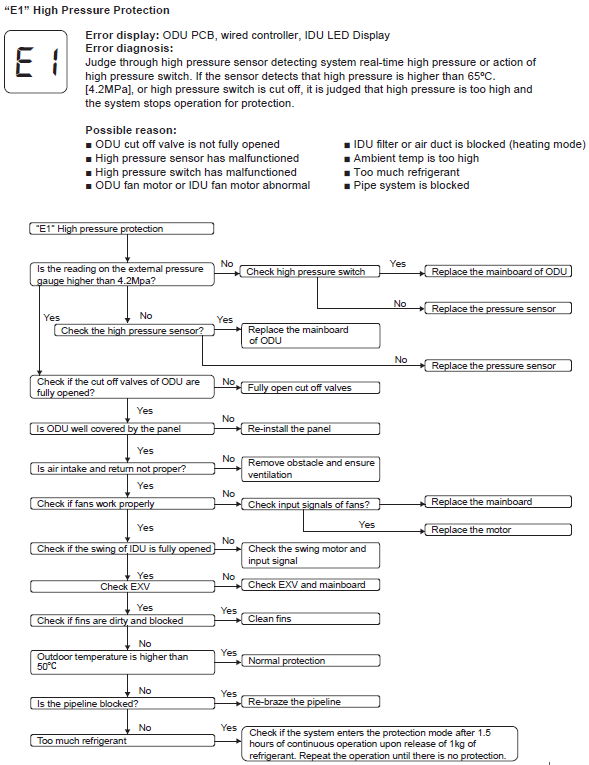
E1 – High Pressure Protection indicates the system has detected excessive refrigerant pressure and has stopped operation to protect the compressor and refrigerant circuit.
This is a protective shutdown, not automatically a component failure.
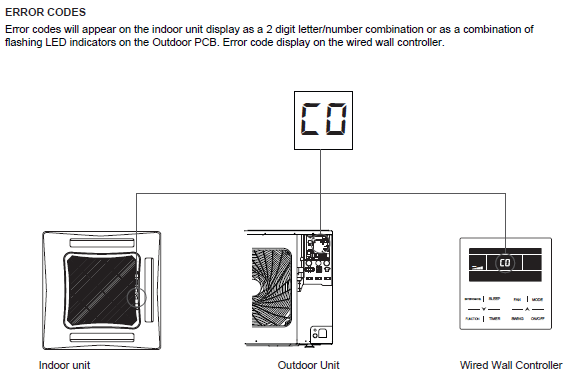
Where the Error Is Displayed
- Outdoor Unit PCB
- Wired Wall Controller
- Indoor Unit LED display
Protection Trigger Condition
The system will enter E1 protection when either of the following occurs:
- The high‑pressure sensor detects pressure above 4.2 MPa
- The high‑pressure switch opens (cut‑out condition).pdf).pdf)
What E1 Means
E1 means the air conditioner cannot safely release heat.
When heat cannot be dissipated, refrigerant pressure rises and the unit shuts down for safety.
The cause differs depending on whether the system is heating or cooling.
E1 in Heating Mode vs Cooling Mode
? Heating Mode (Most Common)
What’s Happening (Simple Explanation)
In heating mode:
- Heat is released indoors
- If air cannot move freely across the indoor unit or ductwork, heat builds up
- Pressure rises and E1 protection activates
Common Heating‑Mode Causes
- Dirty or blocked indoor air filters
- Restricted or collapsed ducting
- Supply air outlets not opening
- Indoor fan not operating correctly
- Poor indoor airflow.pdf).pdf)
How to Explain This to a Customer
“When heating, the system has to move warm air into the home.
If airflow is restricted, pressure builds up and the unit switches off to protect itself.”
First Checks (Heating Mode)
- Clean or replace indoor air filters
- Confirm all vents and ducting are open
- Verify indoor fan operation
- Remove airflow obstructions near return air
❄️ Cooling Mode
What’s Happening
In cooling mode:
- Heat must be expelled outdoors
- If the outdoor unit cannot release heat, pressure rises and E1 protection occurs
Common Cooling‑Mode Causes
- Outdoor unit airflow obstructed
- Dirty condenser coil or fins
- Outdoor fan not operating
- Very high outdoor ambient temperature
- Excess refrigerant charge
How to Explain This to a Customer
“When cooling, the air conditioner dumps heat outside.
If the outdoor unit can’t breathe properly, the unit shuts itself down.”
First Checks (Cooling Mode)
- Remove obstructions around outdoor unit
- Clean outdoor coil / fins
- Confirm outdoor fan operation
- Ensure adequate ventilation around unit
Technician Diagnostic Summary
Possible Technical Causes
- Outdoor service (cut‑off) valves not fully open
- Faulty high‑pressure sensor
- Faulty high‑pressure switch
- Indoor or outdoor fan motor abnormal
- Blocked filters or ducting (heating mode)
- Ambient temperature exceeding allowable limits (≈50 °C)
- Excess refrigerant charge
- Blocked or restricted pipework
Diagnostic Procedure
Step 1 – Confirm System Pressure
- Connect external gauges
- Confirm high‑side pressure relative to 4.2 MPa threshold
Step 2 – Refrigerant Circuit
- Confirm all service valves fully open
- Inspect for blocked or restricted pipework
Step 3 – Airflow & Fans
- Check indoor and outdoor fan operation
- Inspect filters, fins, coils and ducting
- Confirm louvers/swing motors operate correctly
Step 4 – Ambient Conditions
- Outdoor temperature above 50 °C may result in normal protective shutdown
- Improve airflow or shading if possible
Step 5 – Refrigerant Charge (If Overcharge Suspected)
- Recover refrigerant in 1 kg increments
- Run system for approximately 1.5 hours
- Repeat until protection no longer occurs
Step 6 – Test High‑Pressure Safety Components
(Manual reference: E1 diagnostic flowchart, Pages 24–25)
Only perform this step after airflow, refrigerant charge, ambient conditions and pipework have been ruled out.
6.1 High‑Pressure Sensor (Primary Check)
Purpose: Sends real‑time pressure data to the ODU PCB.
Checks:
- Power OFF → inspect wiring and connector (reseat if required)
- Run system and compare:
- Actual high‑side pressure (gauge)
- Pressure value seen by controller / diagnostics (if available)
Interpretation:
- Normal gauge pressure but E1 active → sensor likely faulty
- Signal fixed or erratic → replace pressure sensor
6.2 High‑Pressure Switch (Safety Cut‑Out)
Purpose: Hard safety switch that shuts the system down at excessive pressure.
Checks:
- Power OFF → continuity test across switch
- With normal pressure, switch should be closed
Interpretation:
- Open circuit at normal pressure → replace pressure switch
- Do not bypass or bridge
6.3 Outdoor Main Control Board (ODU PCB)
Only suspect the PCB if:
- Pressure sensor tests correctly
- Pressure switch is closed and functional
- Actual system pressure is normal
Indicators:
- Incorrect pressure interpretation
- E1 occurs immediately on start‑up despite correct inputs
Action: Replace outdoor unit main control board
Step 6 – Quick Decision Guide
| Observation | Likely Cause | Action |
|---|---|---|
| Normal pressure, E1 active | Pressure sensor | Replace sensor |
| Switch open at normal pressure | Pressure switch | Replace switch |
| Sensor & switch OK, fault persists | ODU PCB | Replace PCB |
Corrective Actions Summary
- Fully open service valves
- Restore correct airflow
- Rectify fan issues
- Remove pipe restrictions
- Correct refrigerant charge
- Replace faulty sensor, switch, or PCB if required
Key Support Notes
- ✅ E1 is most commonly an airflow or installation issue
- ❌ Not automatically a compressor fault
- ⚠️ Never bypass safety pressure devices
- Ongoing E1 faults require licensed refrigeration diagnosis
Reference
Braemar VRF Flowcharts – Service Manual (VRFODU‑PT1‑03‑A)
Section E – E1 High Pressure Protection, Pages 24–25.
E1 High Pressure Protection - VRF - GMV5 MCMX MCSX MCHX MCRX