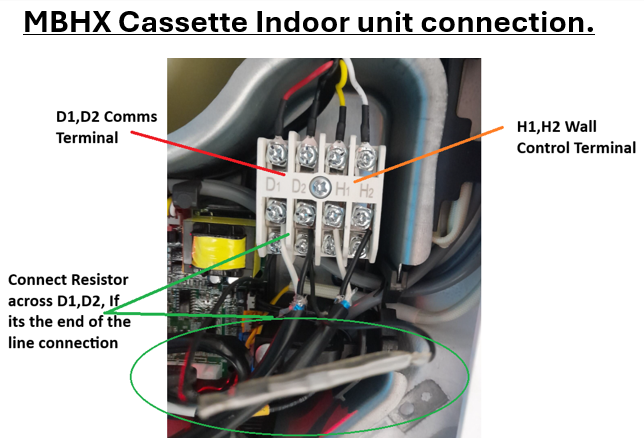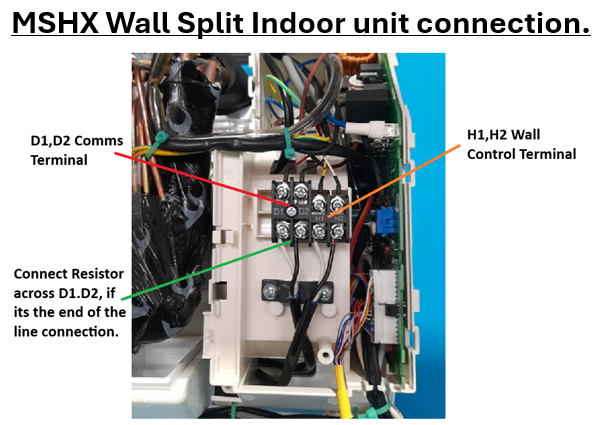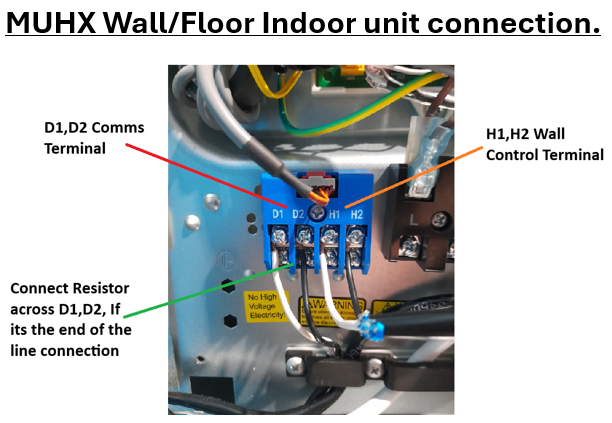
VRF Wiring Guide – D1/D2 & H1/H2 Explained (MBHX MSHX MUHX)
⚠️ Safety Notice – Reverse Cycle Air Conditioners
This equipment must only be installed, commissioned, serviced and repaired by suitably qualified and licensed personnel.
Before commencing work, complete a task-specific risk assessment and ensure electrical isolation procedures, safe access, adequate service clearances and appropriate PPE have been considered. All work must comply with applicable regulations, standards and manufacturer requirements.
Particular care must be taken when working around electrical systems, refrigerant circuits, moving parts, roof spaces, ceiling spaces, confined spaces and working-at-heights hazards where applicable.
Do not proceed if safe access, required clearances, confined space risks or appropriate safety controls cannot be achieved and maintained.
Safety takes priority over diagnosis, repairs, installation schedules and customer expectations. If the task cannot be completed safely, it must not proceed until the risks have been adequately controlled.
Quick Summary
| Circuit | What it does | How to wire it |
|---|---|---|
| D1 / D2 | Outdoor ↔ Indoor communication | Daisy chain all indoor units |
| H1 / H2 | Wall controller ↔ Indoor units | Daisy chain to all controlled units |
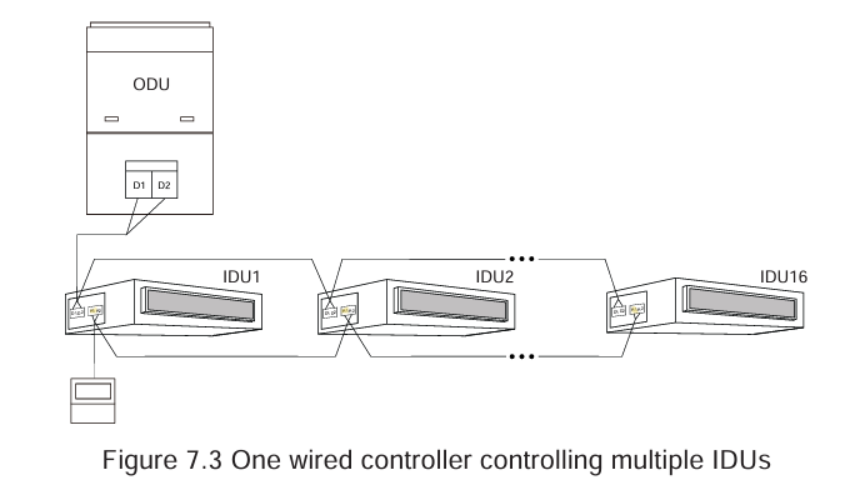
1. D1 / D2 – Outdoor to Indoor Communication
What it is
- These wires allow all units to talk to each other
How to wire it (IMPORTANT)
- Must be wired in a straight line (daisy chain)
- Start from the outdoor unit and link through each indoor
Correct layout
Outdoor → Indoor 1 → Indoor 2 → Indoor 3 → etc.
Key rules
- ✅ Wire unit-to-unit (loop through terminals)
- ✅ Keep polarity the same: D1 → D1, D2 → D2
- ✅ Fit the resistor on the last indoor unit only
Avoid this
- ❌ No star / junction wiring
- ❌ No branching cables
2. H1 / H2 – Wall Controller Wiring
What it is
- Communication between the wired controller and indoor units
When it applies
- Only relevant when one controller runs multiple indoor units
How to wire it
- Must also be daisy chained between all units
Correct layout
Controller → Indoor 1 → Indoor 2 → Indoor 3
Key rules
- ✅ Daisy chain unit-to-unit
- ✅ Match polarity: H1 → H1, H2 → H2
- ✅ Ensure the loop goes through every indoor being controlled
Avoid this
- ❌ Do NOT run separate cables back to the controller
- ❌ Do NOT create star wiring
3. Simple Way to Think About It
You have two separate loops:
Loop 1 (D1/D2):
Outdoor → all indoor units (system communication)Loop 2 (H1/H2):
Controller → all indoor units (control signal)
4. Installer Checklist (Quick Fault Prevention)
Before powering up, check:
- ✅ D1/D2 runs through every indoor unit
- ✅ No breaks or star connections
- ✅ Last indoor has resistor fitted
- ✅ H1/H2 reaches all indoor units being controlled
- ✅ All polarities match (D1-D1, D2-D2, H1-H1, H2-H2)
Common Fault Cause
Most communication faults come from:
- Missed indoor unit in the loop
- Star wiring instead of daisy chain
- Missing end resistor
- Polarity reversed