
Braemar VRF H‑Faults (H5 / H6 / H8 / H9 / HJ / HC)
Outdoor Fan Motor vs Fan Drive Board – Diagnostic Guide
(MCHX (2 pipe – Heat Pump) / MCRX (3 pipe – Heat Recovery) Top Discharge Models
⚠️ Safety Notice – Reverse Cycle Air Conditioners
This equipment must only be installed, commissioned, serviced and repaired by suitably qualified and licensed personnel.
Before commencing work, complete a task-specific risk assessment and ensure electrical isolation procedures, safe access, adequate service clearances and appropriate PPE have been considered. All work must comply with applicable regulations, standards and manufacturer requirements.
Particular care must be taken when working around electrical systems, refrigerant circuits, moving parts, roof spaces, ceiling spaces, confined spaces and working-at-heights hazards where applicable.
Do not proceed if safe access, required clearances, confined space risks or appropriate safety controls cannot be achieved and maintained.
Safety takes priority over diagnosis, repairs, installation schedules and customer expectations. If the task cannot be completed safely, it must not proceed until the risks have been adequately controlled.
Applicability & Scope
This article applies ONLY to Braemar VRF outdoor units fitted with DC inverter fan motors and fan drive (IPM) boards, including:
- MCHX – Modular VRF
- MCRX – Modular VRF
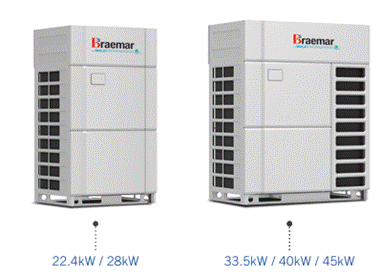
❌ Does NOT apply to MCMX Mini VRF or MCSX Slim VRF Side Discharge models, which use a different fan control system.
Purpose
Outdoor VRF H‑faults related to the fan system can be caused by either:
- A faulty fan motor, or
- A faulty fan drive board
Because fault codes and symptoms overlap, this guide explains how to check the fan motor first, to avoid replacing the wrong part.
Applicable Outdoor Fan H‑Fault Codes
- H5 – Fan over‑current
- H6 – Fan IPM protection
- H8 – Fan IPM over‑temperature
- H9 – Fan lost synchronisation
- HJ – Fan failed to start
- HC – Fan current detection fault
Diagnostic Procedure
Step 1 – Mechanical Fan Check
- Turn power OFF.
- Spin the outdoor fan by hand.
Results:
- ✅ Spins freely → Continue testing
- ❌ Tight, seized, scraping, or noisy → Replace fan motor
⚠️ If the fan does not spin freely, do not replace the fan drive board.
Step 2 – Visual & Wiring Check
Check:
- Fan blade clearance
- Motor shaft for rust or debris
- Wiring between motor and drive board
- Plugs for corrosion or moisture
Fix any visible issues before continuing.
Step 3 – Electrical Check of the Outdoor Fan Motor
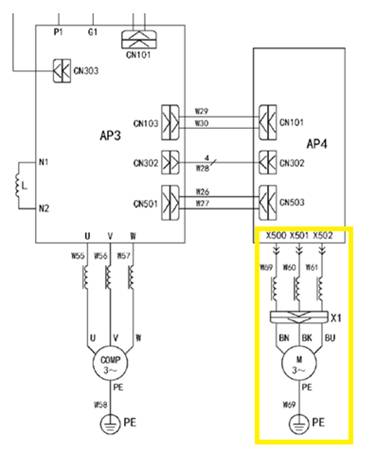
SINGLE FAN OUTDOOR UNIT:
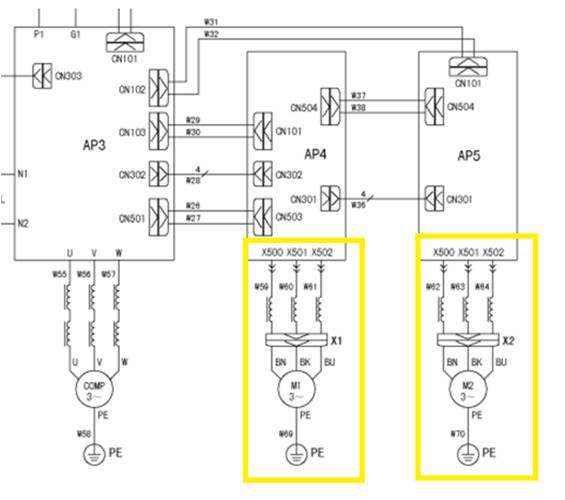
TWIN FAN OUTDOOR UNIT
What you’re checking
The fan motor has three internal windings.
All three should act the same.
⚠️ Important
- Power OFF
- Wait 5 minutes
- Unplug the fan motor from the drive board
3.1 Resistance Test (Ohms Test)
How to test
- Set your multimeter to Ohms (Ω)
- You will see three wires from the fan motor
- Measure resistance between each pair:
- Wire 1 ↔ Wire 2
- Wire 2 ↔ Wire 3
- Wire 3 ↔ Wire 1
(Wire colours don’t matter)
What’s normal
✅ All readings:
- Are under 10 ohms
- Are very close to being equal to each other
Faulty result
❌ The fan motor is faulty if:
- Any reading is OL / open circuit
- Any reading is much higher or lower than the others
- Any reading is over 10 ohms
3.2 Earth Test (Insulation Test)
How to test
- Use a Megger (500V)
- Test each motor wire to earth (metal frame)
- Wire 1 → Earth
- Wire 2 → Earth
- Wire 3 → Earth
What’s normal
✅ All readings above 2 mega‑ohms (MΩ)
Faulty result
❌ The fan motor is faulty if:
- Any reading is below 2 MΩ
- Any wire shows continuity to earth
What the results mean
Result | Action |
Fan stiff or fails electrical tests | Replace fan motor |
Fan spins freely and passes all tests | Motor OK |
Step 4 – Fan Drive Board Decision
If:
- The fan spins freely
- All resistance readings are equal and under 10 Ω
- All insulation readings are above 2 MΩ
- Wiring is confirmed OK
and the H‑fault remains active:
➡ The fan drive (inverter/IPM) board is faulty and may be replaced.
Key Reminders for Technicians
- Always test the fan motor first for H‑faults
- You are checking for matching readings, not phase identity