⚠️ Safety Notice – Gas Heating Products
This appliance must only be installed, commissioned, serviced and repaired by suitably qualified and licensed personnel.
Before commencing work, complete a task-specific risk assessment and ensure gas and electrical safety requirements, ventilation provisions, safe access, adequate service clearances and appropriate PPE have been considered. All work must comply with applicable regulations, standards and manufacturer requirements.
Particular care must be taken when working around gas systems, electrical components, combustion products, hot surfaces, moving parts, roof spaces, ceiling spaces and confined spaces.
Do not proceed if safe access, required clearances, ventilation requirements, confined space risks or appropriate safety controls cannot be achieved and maintained.
Safety takes priority over diagnosis, repairs, installation schedules and customer expectations. If the task cannot be completed safely, it must not proceed until the risks have been adequately controlled.
Component Testing & Fault Diagnosis
Braemar TQ Gas Heater
TQ Service Guide 2023 (Doc 644066M)
1. Purpose
This article provides step‑by‑step component testing and fault diagnosis procedures for Braemar TQ series ducted gas heaters.
It enables trained and authorised service technicians to:
- Diagnose faults directly from this article
- Confirm electrical, airflow, and control integrity before replacing components
Source reference: TQ Service Guide 2023 (Doc 644066M)
Important – Authorised Service Use Only
This article is intended exclusively for qualified, licensed, and authorised gas‑heating service technicians.
It assumes familiarity with:
- Gas appliance servicing
- Electrical testing methods
- Braemar Integrated Control System (ICS)
Incorrect testing methods or unsafe work practices may result in serious injury, property damage, regulatory non‑compliance, or equipment damage.
Always follow:
- Local gas and electrical safety regulations
- Applicable Australian Standards
- Site‑specific isolation and safety procedures
If you are not appropriately trained or authorised, do not proceed.
2. Models Covered
✅ Included Models
Single‑Stage (On/Off Gas Control)
- TQ3
- TQMD3
- BMQ3
- TQD3
Two‑Stage (Low / High Fire)
- TQ4
- TQ5
- SSQ4
Modulating (ICS Gas Modulation)
- TQM5
- TQMD5
- TQM6
- SSQ5
- TQS models fitted with FCC room fans
✅ All included models operate on the Braemar Integrated Control System (ICS)
⚠️ Excluded Models
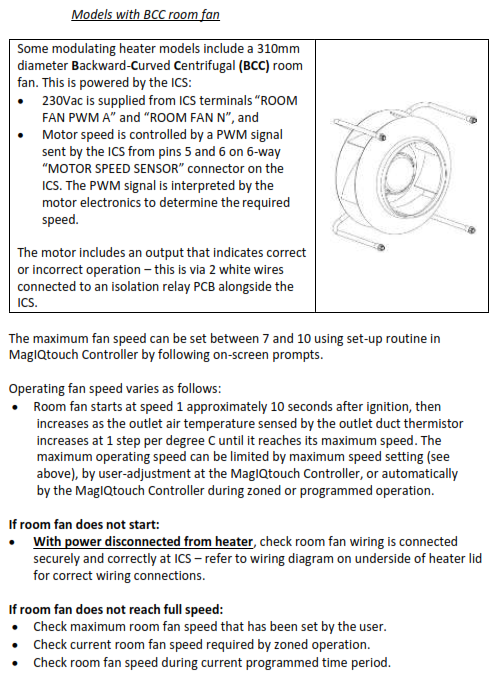
Models fitted with Backward‑Curved / EBM (BCC) room fans, including:
- TQS7
- Supernova BCC variants
These models use different fan‑control logic and are covered under separate procedures.
Service Guide alignment: Section 2 – Heaters Covered by This Manual (pp. 6–7)
3. Related Articles
Use the following knowledge base articles together with this procedure:
Fault Diagnostics
- TQ & TQM Heater Fault Code Diagnostics
(Fault Codes FC and Lockout Levels L0 / L1 / L2) - ICS Indicator LED Identification Guide
Gas & Commissioning
- Gas Pressure Setup – TQ Series
(Single‑stage, two‑stage, and modulating valve adjustment)
Click below link to view:
TQ TQM Fault Code (FC errors) Diagnostics & ICS indicator LED's 2023: Seeley International Pty Ltd
TQ DGH - Gas Valve Identification and Gas Pressure setting: Seeley International Pty Ltd
4. Mandatory Safety Requirements
⚠️ Gas heater component testing must only be performed by qualified and licensed service personnel
Before any testing:
- Isolate 230 Vac electrical supply
- Isolate gas supply where required
- Perform a full visual inspection
- Use a calibrated multimeter capable of:
- AC voltage
- DC voltage
- Resistance (Ω)
- Follow all local gas and electrical safety regulations
⚠️ Never ohms‑test a live circuit
⚠️ Never disconnect components under load
Service Guide alignment: Section 1 – Introduction & Safety (pp. 5–6)
5. Pre‑Test Checklist (ALWAYS COMPLETE FIRST)
Click below link to view:
TQ TQM Fault Code (FC errors) Diagnostics & ICS indicator LED's 2023: Seeley International Pty Ltd
- Restore power and call for heat
- Retrieve stored and active fault codes:
MagIQtouch → Settings → Service → Fault Log - Record:
- Fault code(s)
- Lockout level (L0 / L1 / L2)
- Turn heater OFF
- Isolate 230 Vac
Confirm:
- All wiring looms fully seated
- No signs of overheating or moisture ingress
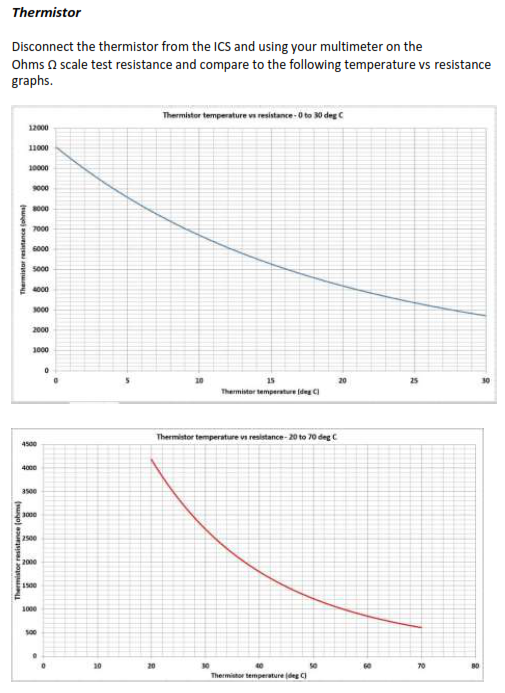
- Outlet air thermistor located approx. 3 m along outlet duct
6. Component Testing Procedures
All testing below can be followed step‑by‑step on site.
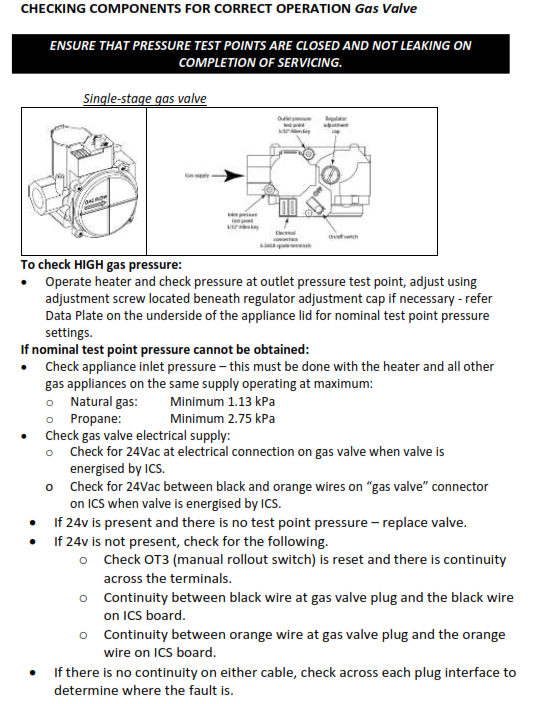
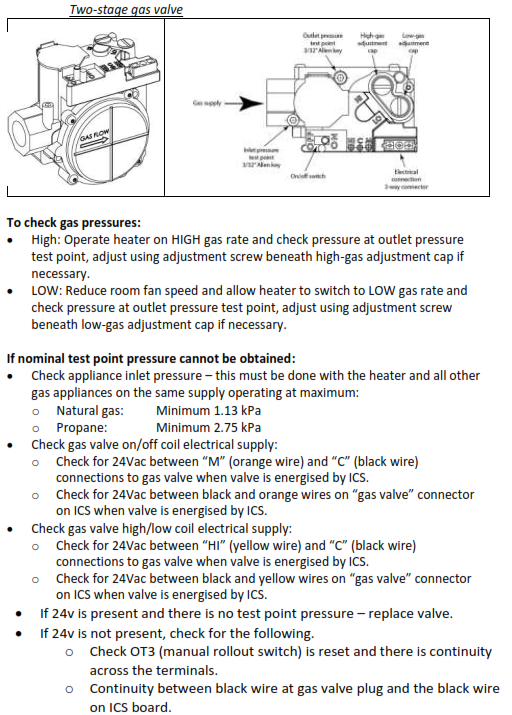
6.1 Gas Valve Testing
Important Notes
- TQ heaters use White‑Rodgers gas valves
- These valves contain internal rectifiers/diodes
- Standard resistance testing may give misleading readings
✅ Gas valve operation must be confirmed using live voltage AND gas flow
Click below link to view:
TQ DGH - Gas Valve Identification and Gas Pressure setting: Seeley International Pty Ltd
6.1.1 Single‑Stage Gas Valve (On / Off Only)
A. Coil Resistance Test (Power OFF – Limited Use)
Purpose:
Used only to identify hard electrical coil failures.
This test does not confirm correct gas valve operation.
Assessment
✅ True open circuit
(no continuity in both polarities, valve unplugged)
→ Failed coil✅ Near‑zero Ω (dead short)
→ Failed coil❌ OL or unstable readings in one direction only
→ NOT a valid failure indicator
(internal rectifiers/diodes may block the meter)
B. Live Voltage & Gas‑Flow Test (PRIMARY TEST)
Purpose:
Confirms the ICS is commanding the valve AND the valve is mechanically opening.
Procedure
- Restore power
- Call for heat
- Measure voltage at:
- Orange ↔ Black
- ✅ Expect 24 Vac during ignition sparking
Gas‑Flow Confirmation
- Connect manometer to the operating test point
- Gas must be present within 4 seconds of ignition sparking starting
Decision
✅ 24 Vac + gas flow present
→ Valve operating correctly✅ 24 Vac present + NO gas flow (after 4 s)
→ Valve slow opening or sticking → Replace valve❌ No 24 Vac present
→ Fault is not the valve
(check OT3, safeties, airflow proving, ICS)
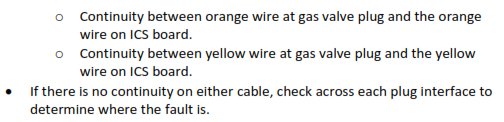
6.1.2 Two‑Stage Gas Valve (Low / High Fire)
A. Coil Resistance Test (Power OFF – Limited Use)
Purpose:
Used only to identify hard electrical coil failures on either stage.
Resistance testing alone does not confirm correct staging or operation.
Assessment (Either Coil)
✅ True open circuit
→ Failed coil – replace entire valve✅ Near‑zero Ω (dead short)
→ Failed coil – replace entire valve❌ OL or odd readings one way only
→ NOT a valid failure indicator
Wiring Identification
- Black = Common
- Orange = Main ON / OFF (Low fire supply)
- Yellow = High fire stage
B. Live Voltage & Gas‑Flow Test (PRIMARY TEST)
Purpose:
Confirms correct staging command from the ICS and physical valve response.
High‑Fire Operation
- Orange ↔ Black = 24 Vac
- Yellow ↔ Black = 24 Vac
✅ Confirms valve is being commanded to high fire
Low‑Fire Operation
- Orange ↔ Black = 24 Vac
- Yellow ↔ Black = 0 Vac
✅ Confirms valve has dropped to low fire
Gas‑Flow Confirmation (Both Stages)
- Connect manometer to test point
- Gas must be present within 4 seconds of ignition sparking
Decision
✅ Correct voltage + gas flow present
→ Valve operating correctly✅ Correct voltage + NO gas flow (after 4 s)
→ Valve slow opening or sticking → Replace valve❌ No 24 Vac to Orange
→ Fault is not the valve
(check OT3, safeties, airflow proving, ICS)
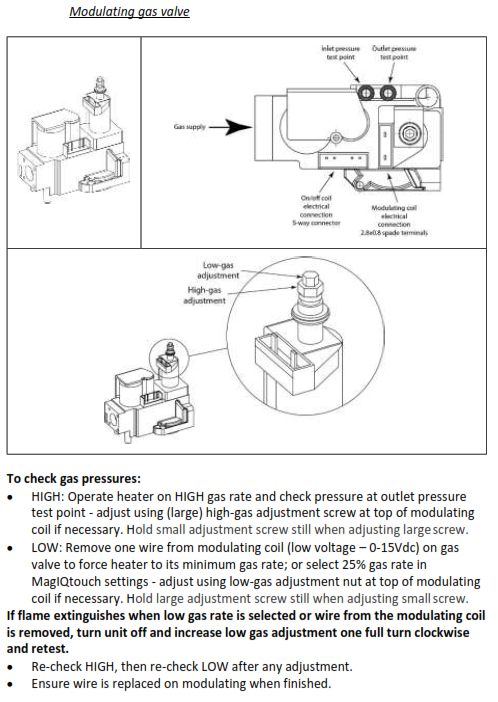
6.1.3 Modulating Gas Valve (ICS Modulation)
✅ Resistance testing is VALID for modulating gas valves
(Modulating valves use separate, non‑rectified coils)
A. Coil Resistance Test (Power OFF)
Purpose:
Confirms electrical integrity of both coils before live testing.
Setup
- Heater OFF
- 230 Vac isolated
- Gas valve plug disconnected
- Multimeter set to Ω
Expected Readings
| Coil | Probe Points | Normal |
|---|---|---|
| On/Off (Main) | Black ↔ Orange | 50–52 Ω |
| Modulating | Blue ↔ Purple | 86–88 Ω |
Decision
- ✅ Readings within range → Proceed to live signal test
- ❌ Any open circuit, short circuit, or out‑of‑range value → Replace entire gas valve
B. Live Signal Test (Power ON)
Purpose:
Confirms ICS is commanding valve operation and modulation.
Procedure
- Restore power
- Call for heat
- Measure signals at the gas valve with plug connected
Expected Signals
On/Off coil (Black ↔ Orange):
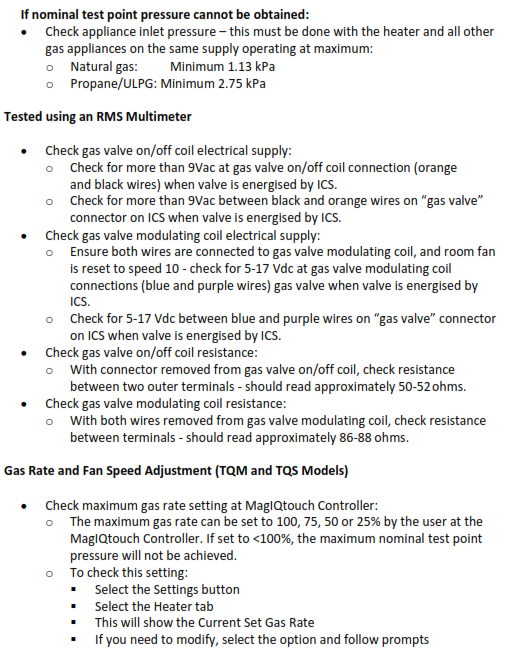
✅ >9 Vac when valve is commanded ONModulating signal (Blue ↔ Purple):
✅ 5–17 Vdc, varying with heat demand
Decision
- ✅ Correct voltage present and modulation active → Valve operating normally
- ✅ Correct voltage present but no modulation or gas response → Valve fault → Replace valve
- ❌ No control voltage present → ICS or wiring fault (do not replace valve) - Check OT3, safeties, airflow proving, ICS)
6.2 Combustion Fan Testing
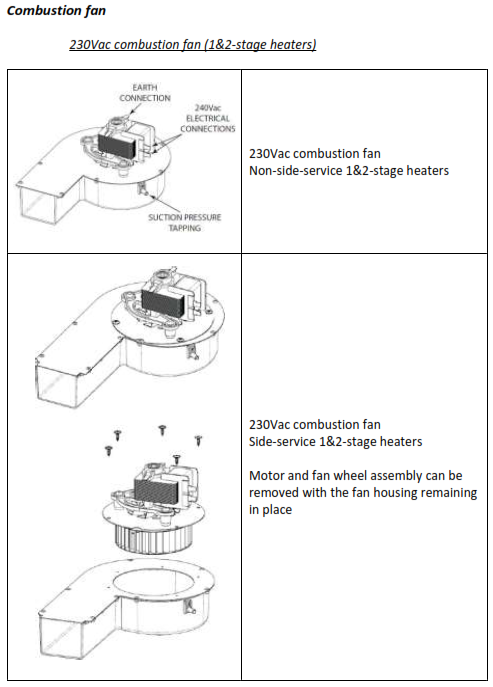
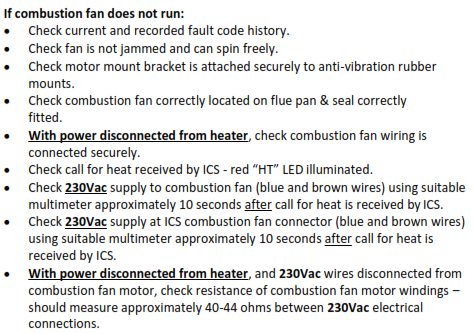
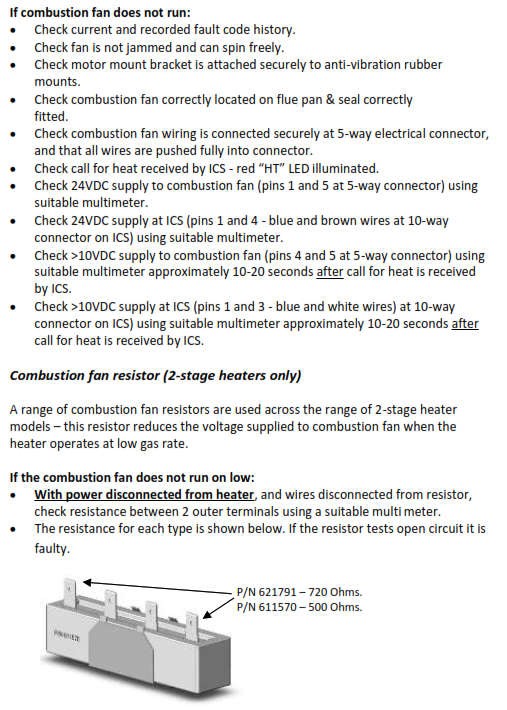
230 Vac Combustion Fan (Single & Two‑Stage)
- Call for heat
- After ~10 s, confirm 230 Vac at fan terminals
- Resistance (isolated): 40–44 Ω
✅ Voltage present but fan not running → Replace fan
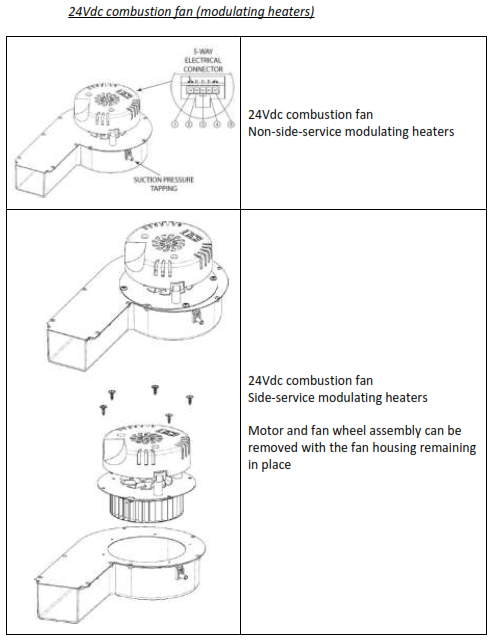
24 Vdc Combustion Fan (Modulating)
- Supply: 24 Vdc (pins 1–5)
- Control: >10 Vdc (pins 4–5 during run‑up)
✅ Voltage correct, fan not running → Replace fan
6.3 Combustion Fan Resistor (Two‑Stage Only)
| Part Number | Resistance |
|---|---|
| 621791 | 720 Ω |
| 611570 | 500 Ω |
❌ Open circuit → Replace resistor
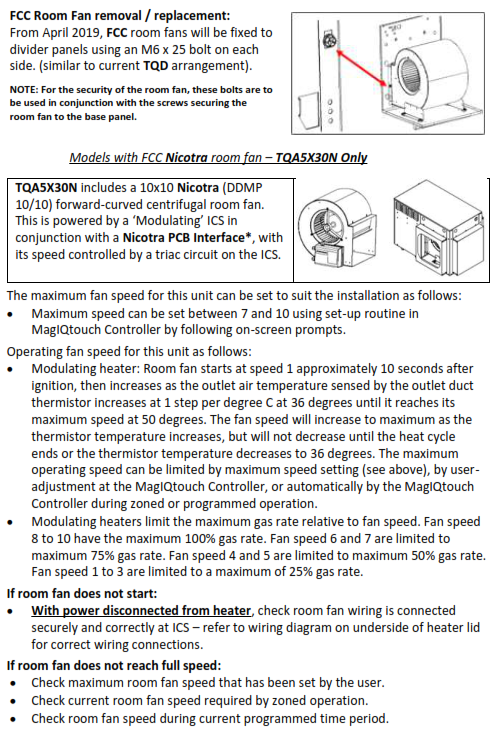
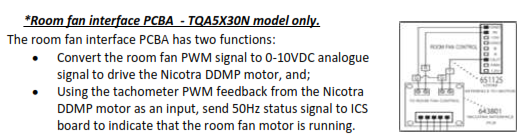
6.4 Room Fan Systems
Click link below to view
Room Fan Motor Testing for TQ/TQM Heaters: Seeley International Pty Ltd
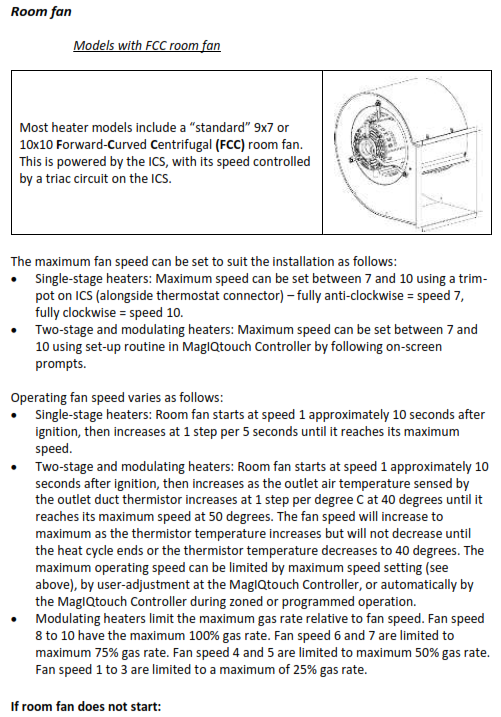
FCC Room Fan (Standard TQ Models)
Operation:
- Starts ~10 s after ignition
- Gradual speed ramp
- Modulates from outlet thermistor
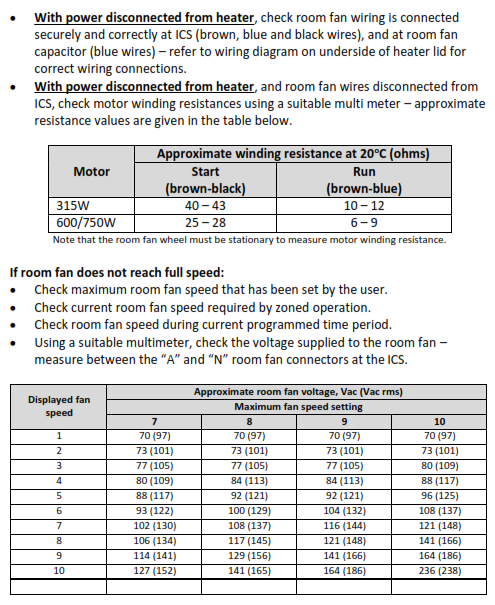
Winding Resistance (Power OFF)
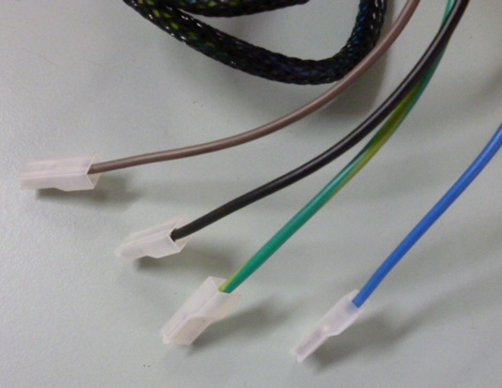
| Motor | Start (Br↔Blk) | Run (Br↔Blu) |
|---|---|---|
| 315 W | 40–43 Ω | 10–12 Ω |
| 600–750 W | 25–28 Ω | 6–9 Ω |
Capacitor Testing:
• Disconnect power and discharge the capacitor safely.
• Use a multimeter with capacitance mode or a dedicated capacitor tester.
• Compare measured capacitance to the rated value (typically printed on the capacitor).
• A reading significantly lower than the rated value or no reading at all indicates a faulty capacitor.
• Visually inspect for bulging, leakage, or discoloration.
IMPORTANT NOTE: Check correct value from service and spare parts manual NOT what is on motor label as the capacitors change depending on the heater model
Additional Checks:
• Inspect for physical obstructions or debris in the fan housing
• Confirm ICS is receiving power and functioning correctly
• Check for blown fuses or tripped breakers
• Inspect for signs of overheating or burnt components
________________________________________
Fan Does Not Reach Full Speed
Verify:
• Maximum speed setting
• Zoned operation speed
• Programmed time period speed
Voltage Check:
To verify correct voltage supply to the motor, follow the steps below:
Run Voltage Measurement:
Using a multimeter, measure the voltage across terminals “A” (Active) and “N” (Neutral) at the ICS (Integrated Control System).
This voltage corresponds to the motor’s run winding and will vary depending on the fan speed selected by the heater.
Start Voltage Measurement:
Additionally, measure the voltage across terminals “CAP” (Capacitor) and “N” (Neutral) at the ICS.
This voltage energizes the start winding via the capacitor and is typically higher than the voltage across “A” and “N”, especially during motor startup.
Note: The presence of voltage at “CAP” and “N” confirms that the start capacitor circuit is functioning. If there is no voltage present on these terminals, then strongly recommend testing the separate Room Fan Capacitor connected to CAP and CAP on the ICS.
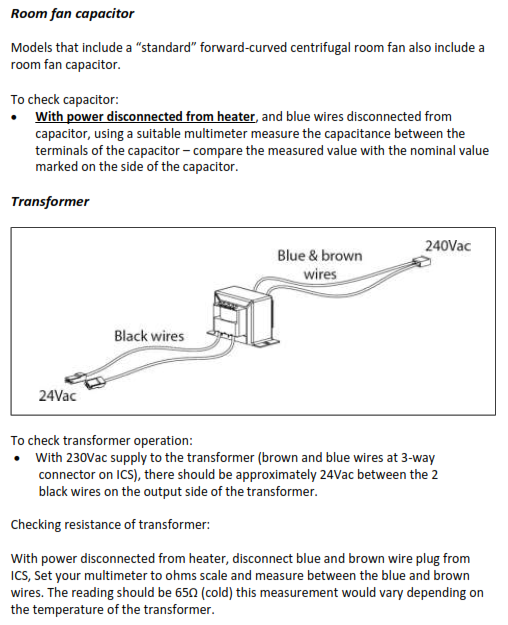
6.5 Transformer
- Input: 230 Vac (Brown ↔ Blue)
- Output: ~24 Vac (Black ↔ Black)
- Resistance: ~65 Ω
❌ Out of range → Replace transformer
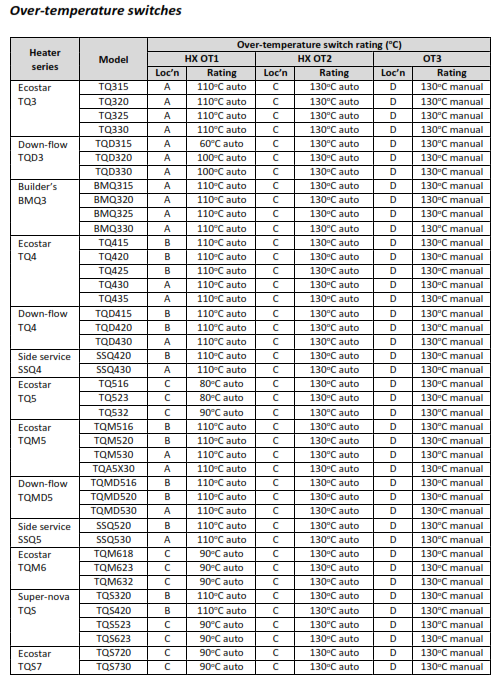
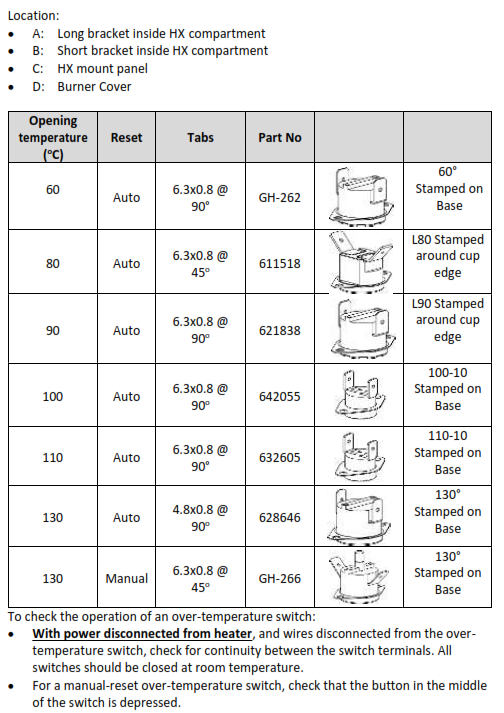
6.6 Over‑Temperature Switches (OT1 / OT2 / OT3)
- Heater isolated
- Continuity test
- All must be closed when cold
- OT3 requires manual reset
6.7 Outlet Air Thermistor
| Temperature | Resistance |
|---|---|
| 25 °C | ~3.3 kΩ |
| 50 °C | ~1.2 kΩ |
| 70 °C | ~580 Ω |
❌ Incorrect or unstable → Replace thermistor
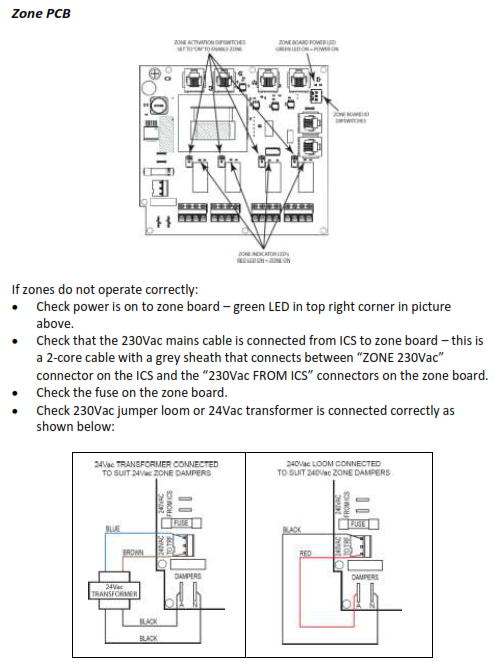
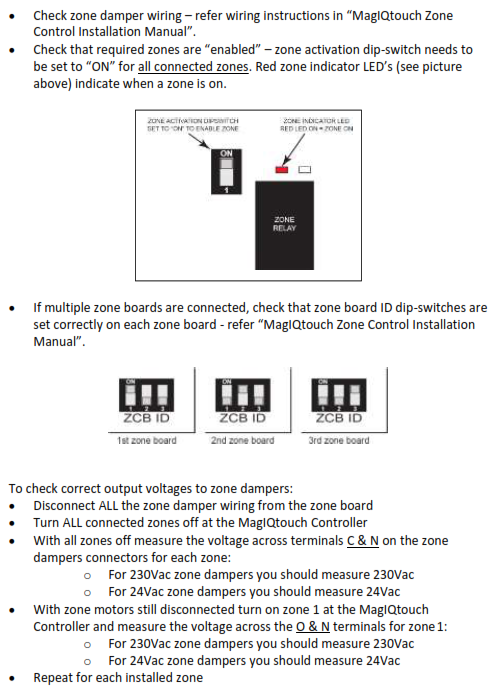
6.8 Zone PCB (If installed)
- Green LED ON = board powered
- Check fuse
- Damper output:
- 230 Vac systems → 230 Vac
- 24 Vac systems → 24 Vac
❌ No output → Wiring or PCB fault
7. Completion Requirements
Before leaving site:
✅ All wiring restored and secured
✅ Gas pressure test points sealed
✅ Fault codes cleared
✅ Heater completes full ignition and run cycle
| Section | Component / Topic | Service Manual Section | Page(s) |
|---|---|---|---|
| 1 | Safety, Purpose, Authorised Use | Section 1 – Introduction and Safety | 5–6 |
| 2 | Models Covered | Section 2 – Heaters Covered by This Manual | 6–7 |
| 3 | Startup & Run Logic | Section 3 – Start‑Up and Run Flowcharts | 8–13 |
| 4 | Pre‑Service Requirements | Section 4 – Before Commencing Servicing | 14 |
| 6 (General) | Component Testing Overview | Section 4 – Checking Components for Correct Operation | 17–37 |
| 6.1.1 | Gas Valve – Single‑Stage | Gas Valve – Single‑Stage | 17 |
| 6.1.2 | Gas Valve – Two‑Stage | Gas Valve – Two‑Stage | 18–19 |
| 6.1.3 | Gas Valve – Modulating | Gas Valve – Modulating | 20–21 |
| 6.2 | Combustion Fan (230 Vac & 24 Vdc) | Combustion Fan | 23–26 |
| 6.3 | Combustion Fan Resistor (2‑Stage) | Combustion Fan Resistor | 26 |
| 6.4 | Room Fan – FCC | Room Fan (FCC) | 27–30 |
| 6.4 | Room Fan – BCC / EBM | Room Fan (BCC) | 31 |
| 6.5 | Transformer | Transformer | 32 |
| 6.6 | Over‑Temperature Switches (OT1 / OT2 / OT3) | Over‑Temperature Switches | 33–34 |
| 6.7 | Outlet Air Thermistor | Thermistor | 37 |
| 6.8 | Zone PCB | Zone PCB | 35–36 |
| — | Fault Codes & Lockout Levels | Fault Code & Lockout Summary | 42–46 |
| — | ICS Indicator LEDs | ICS Indicator LEDs | 47–48 |
| 7 | Completion / Post‑Service Checks | Section 4 – Service and Troubleshooting | 14 |
All component tests and procedures align with Braemar TQ Service Guide 2023 (Doc 644066M), Section 4 Service and Troubleshooting, pages 17–37, unless otherwise stated.