⚠️ Safety Notice – Gas Heating Products
This appliance must only be installed, commissioned, serviced and repaired by suitably qualified and licensed personnel.
Before commencing work, complete a task-specific risk assessment and ensure gas and electrical safety requirements, ventilation provisions, safe access, adequate service clearances and appropriate PPE have been considered. All work must comply with applicable regulations, standards and manufacturer requirements.
Particular care must be taken when working around gas systems, electrical components, combustion products, hot surfaces, moving parts, roof spaces, ceiling spaces and confined spaces.
Do not proceed if safe access, required clearances, ventilation requirements, confined space risks or appropriate safety controls cannot be achieved and maintained.
Safety takes priority over diagnosis, repairs, installation schedules and customer expectations. If the task cannot be completed safely, it must not proceed until the risks have been adequately controlled.
⚠️ Important
These checks involve working on live 240V electrical components and must only be carried out by suitably qualified and trained trade personnel.
If you are not qualified to test electrical appliances, do not proceed with these steps. Incorrect testing can result in electric shock, injury, or damage to equipment.
Purpose
To confirm whether a room fan motor and capacitor are serviceable using:
- Visual inspection
- Resistance testing
- Capacitor testing
- Live voltage checks
⚠️ Safety First
- Isolate 240V power supply before testing
- Discharge capacitor before handling
- Only reconnect power when performing live tests
- Disconnect motor wiring before resistance testing
✅ Before You Start – Quick Checks
Before carrying out any testing, confirm the following:
1. Controller Fan Speed Setting
- Ensure the Spectrolink controller fan speed is set to 10 (maximum)
- A low fan speed setting will:
- Limit voltage to the motor
- Prevent the fan from reaching full speed
- Lead to incorrect fault diagnosis
2. Return Air & Airflow
- Check:
- Return air filter is clean
- Return air grille is not blocked
- Adequate airflow through system
✅ Poor airflow can cause the fan to stay at low speed
3. Duct Condition
- Check for:
- Crushed duct
- Air leaks
- Restrictions
✅ Airflow issues will prevent the thermistor from warming up correctly
4. Capacitor Quick Check
- Look for:
- Bulging or leaking capacitor
- If unsure → swap with known good capacitor first
✅ This is the most common cause of fan motor issues
⚠️ These checks should always be completed before replacing a motor
1. Visual Inspection (Quick Check)
Before using a meter:
- Spin motor shaft by hand → should rotate freely
- Check for:
- Burn marks / overheating
- Loose or damaged wiring
- Signs of capacitor failure (bulging, leaking)
- Confirm correct motor and capacitor fitted for model
✅ If seized or physically damaged → Replace motor
2. Capacitor Testing (Critical Step)
⚠️ Capacitor faults are common and often misdiagnosed as motor failure
2.1 Quick Functional Signs of Failure
Replace capacitor if:
- Swollen or leaking
- Motor hums but won’t start
- Motor runs only when spun by hand
✅ If unsure → swap with a known good capacitor (fastest check)
2.2 Capacitance Test (Using Multimeter)
Setup
- Power OFF
- Disconnect capacitor from circuit
- Fully discharge capacitor
Test
- Set multimeter to µF (capacitance mode)
- Measure across capacitor terminals
Expected Result
- Reading should be within ±10% of rated value
| Rated | Acceptable Range |
|---|---|
| 10µF | 9–11µF |
| 15µF | 13.5–16.5µF |
| 20µF | 18–22µF |
Interpretation
| Result | Diagnosis |
|---|---|
| Within tolerance | Capacitor OK |
| Low reading | Weak capacitor → Replace |
| No reading / OL | Open circuit → Replace |
| Fluctuating reading | Internal fault → Replace |
✅ Best practice: Replace capacitor if in doubt
3. Winding Resistance Test (Motor Test)
Setup
- Power OFF
- Disconnect motor wires
- Ensure shaft is stationary
Test Points
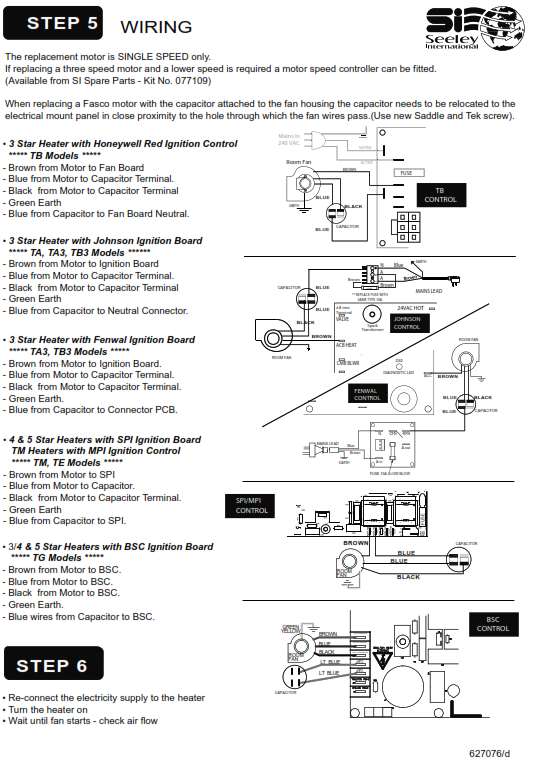
- Brown → Black (Start winding)
- Brown → Blue (Run winding)
Expected Values @ 20°C
| Motor Type | Start (Brown–Black) | Run (Brown–Blue) |
|---|---|---|
| 315W | 40–43 Ω | 10–12 Ω |
| 600/750W | 25–28 Ω | 6–9 Ω |
Interpretation
| Result | Diagnosis |
|---|---|
| Within range | Motor OK |
| Open circuit | Broken winding → Replace motor |
| Very low resistance | Shorted winding → Replace motor |
| Out of range | Faulty motor |
4. Live Voltage Test (Operation Check)
⚠️ Only perform if safe
Check Supply from BSC
Measure between:
- ROOM FAN A
- ROOM FAN N
- ROOM FAN CAP
- ROOM FAN N
Expected Operation
- ~70–100 Vac → Initial low speed (speed 1)
- Up to ~240 Vac → Maximum fan speed
IMPORTANT – Fan Ramp Operation
- Fan always starts on speed 1
- Fan speed increases only as the duct thermistor warms up, increasing voltage to the motor
If Fan Is Not Ramping Up
Check Thermistor
- Must be installed ~3m along outlet duct
- Incorrect position → fan will stay at low speed
Check Ductwork
- Air leaks
- Crushed or restricted duct
- Poor airflow
Quick Interpretation
| Observation | Likely Cause |
|---|---|
| Voltage increases but fan slow | Motor or capacitor fault |
| Voltage stays low (70–100V) | Thermistor / airflow issue |
| No voltage | BSC or wiring fault |
| Fan won’t reach full speed | Controller fan speed set too low |
5. Functional Run Check
With heater operating:
Fan should:
- Start ~10–15 seconds after ignition
- Begin at low speed
- Ramp to full speed (~240V)
Common Fault Indicators
| Symptom | Likely Cause |
|---|---|
| Starts late | Control / airflow issue |
| Runs slow only | Thermistor / ducting |
| Cycles or stops | Overheat or capacitor |
Final Decision Logic
| Test Outcome | Action |
|---|---|
| Motor seized | Replace motor |
| Resistance out of spec | Replace motor |
| Voltage present but no run | Replace motor |
| Starts only when spun | Replace capacitor |
| Capacitor out of tolerance | Replace capacitor |
| No voltage | Fault-find BSC / wiring |
Practical Field Tips
- Always test capacitor and motor together
- Swap capacitor first — quickest elimination step
- Don’t rely on resistance test alone — confirm with live voltage check
- Many “motor faults” are actually airflow or setup issues